Learnings of the 1st Leadership Module - by Manoj Kumar Joshi
The first rays of sunlight lit up my room and I woke up to the cool breeze drifting through my windows. I set off on my journey to the countryside of Germany to learn about leadership. I had my own reservations about the idea of whether leadership can be taught but I was equally enthusiastic. We were welcomed by our leadership coaches Mr. David and Ms. Christine who are filled with excitement and energy.
The leadership module started with an exercise on trust building. This exercise consists of two people, in which one of them must do blind walking and the other shouldn’t speak. One person will close his/her eyes and believe in the other who is guiding the path by tapping shoulders for directions. This becomes tricky when you fumble while walking. When the trust is challenged, the path becomes challenging and unpredictable at times. I think that’s almost similar in our teams too, as we tend to find clear directions, and often don’t trust our colleagues in the process. It’s human to have doubts but the beauty of trust is to allow yourself to believe in one another.
This was the first learning during the first half of the day, and I found out how difficult it is to trust someone. It’s a natural tendency to believe that our best comes out when we are alone and doing things by ourselves. To let that belief in yourself go away for a second is quite impossible. Trust comes with vulnerability and the idea of being at risk is scary when our trust is given to others. With this activity, I learned that assumptions will not work, and clear communication is pivotal for trusting and implementation.
The five (dys-)functions of the team can be summed up in the below pyramid.
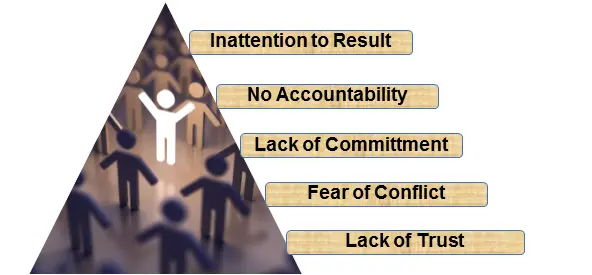
The above pyramid displays that lack to trust will lead to fear of conflict and it percolates to minimal results with the objective being failed. Hence the idea of trust is pivotal in a team setting. This should be ideally the job of the leader/manager to create an environment of trust in the team.
What makes trusting difficult? Why is it so difficult to trust your colleagues in a professional setting?
I would like to ponder upon the yardsticks which hinder trusting. One of the major yardsticks is the “Process of selective perception”. There are various inherent biases that we carry with ourselves, and we tend to look through that lens. Our minds process information very selectively and jump to conclusions. This influences our communication. This can be handled with a three-step process D – I – A.
D – I – A (Dialogue – Inquiry – Acknowledgement):
Dialogue: We must push ourselves in not having our biases creep into any situation and rather be open-minded to hear the perspective of the other person. Often it is the feeling of being heard that makes it a better ground for being vulnerable, which in turn paves to honesty. Being able to empathize is a great skill and is often neglected in workspaces.
Inquiry: There is a major difference between questioning another person to find faults and being genuinely curious to understand the circumstances. When we try to understand other’s scenarios, that successively opens the space for learning.
Acknowledgement: When you place a task over a human being, the idea of empathy, learning and inquiry goes away. When you establish a true understanding, you will be able to acknowledge their feelings, which will result in not judging others.
Conclusion:
The above three steps (D-I-A) will help in building trust with one another as well as in teams. D-I-A is important for bettering various facets of team dynamics. The feedback culture in the team is also equally paramount. In my next blog, I will try to write about how positive feedback culture can boost team morale.
About the author: